
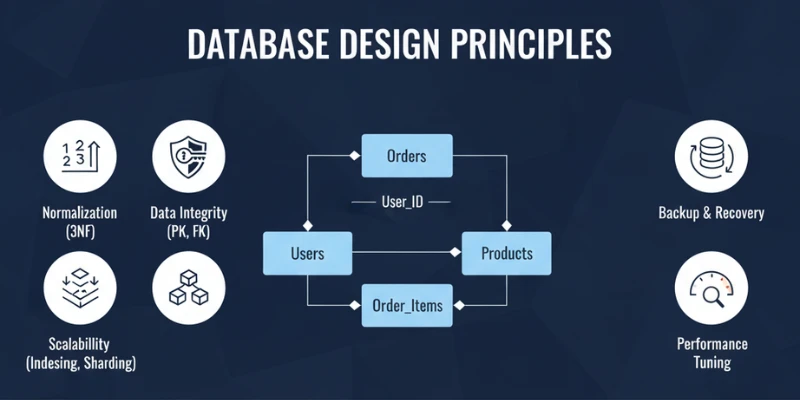
When building full stack applications, a well-structured database is essential for performance, scalability, and ease of maintenance. Whether using relational databases like MySQL or NoSQL databases like MongoDB, understanding key design principles is vital. This knowledge is crucial for any aspiring Full Stack Developer. If you’re looking to enhance your skills, a Full Stack Developer Course in Trivandrum at FITA Academy is an excellent way to master these concepts and build robust applications. Here, we’ll cover the essential database design principles every full stack developer should know.
1. Understand the Data Requirements
The first step in designing a database is understanding the data your application will use. Are you handling structured or semi-structured data? Identifying data types and relationships will help shape the database design.
For example, if your app tracks users and their orders, you need to understand how these entities relate (e.g., one user can have multiple orders). Clear data relationships make it easier to design a functional and efficient database.
2. Normalize Your Data
Normalization involves structuring data in a way that minimizes duplication and maintains consistency. The goal is to minimize duplicate data, making the database more efficient.
A well-designed database typically follows the third normal form (3NF), ensuring non-key columns are fully dependent on the primary key and redundant data is removed. However, don’t over-normalize; excessive normalization can lead to complex joins that slow performance. It’s important to balance normalization with practical needs. For those looking to enhance their full stack development skills, enrolling in a Full Stack Developer Course in Kochi can offer important perspectives on creating efficient, scalable databases.
3. Design for Scalability
Scalability is crucial for handling increased data and user activity over time. A database that performs well with a small dataset may struggle as traffic grows.
Plan for scalability by using indexing for faster queries and considering sharding (splitting data across multiple servers) in NoSQL databases. Designing for scalability means ensuring your database can handle more data and users without major redesigns.
4. Define Relationships Between Data Entities
In relational databases, defining clear relationships between data entities is key. The three main relationship types are:
- One-to-One: One record relates to another (e.g., user profile).
- One-to-Many: One record relates to multiple others (e.g., one customer, many orders).
- Many-to-Many: Records in both tables have multiple relationships (e.g., students enrolled in courses).
Properly structuring these relationships ensures efficient data storage and retrieval.
5. Implement Data Integrity and Constraints
Data integrity is vital for maintaining accurate, consistent data. Constraints like primary keys, foreign keys, unique constraints, and not-null constraints enforce this integrity.
- Primary Keys uniquely identify each record.
- Foreign Keys link related records across tables.
- Unique Constraints ensure no duplicates in key fields.
- Not Null Constraints ensure essential data is never missing.
These constraints prevent invalid data and maintain the integrity of your database. If you’re aiming to excel in full stack development and database design, joining a Full Stack Developer Course in Pune can equip you with the necessary skills to create strong and scalable applications.
6. Optimize for Query Performance
Query performance can be a major bottleneck in larger databases. To improve performance, use indexes on frequently queried columns. Indexing speeds up data retrieval, but excessive indexing can slow down insert or update operations, so use it wisely.
Optimizing queries by selecting only the necessary data, avoiding complex joins, and using stored procedures for common operations can further enhance performance.
7. Backup and Recovery Plans
To safeguard data, you must have a reliable backup and recovery strategy. Consistent backups guarantee that you can retrieve your data if an issue arises. Backup strategies include full, incremental, and transaction log backups. Test your backup process regularly to ensure data can be restored efficiently.
A strong grasp of database design concepts is essential for full stack developers. By focusing on data requirements, normalization, scalability, relationships, data integrity, query performance, and backups, you’ll ensure your applications are robust, efficient, and scalable.
A well-designed database saves time and resources, ultimately supporting the long-term success of your application. To acquire comprehensive knowledge and practical skills, think about signing up for a Full Stack Developer Course in Jaipur, where you will learn to create effective databases that drive successful applications.
Also check: What is Event-Driven Architecture in Back-End Development?